
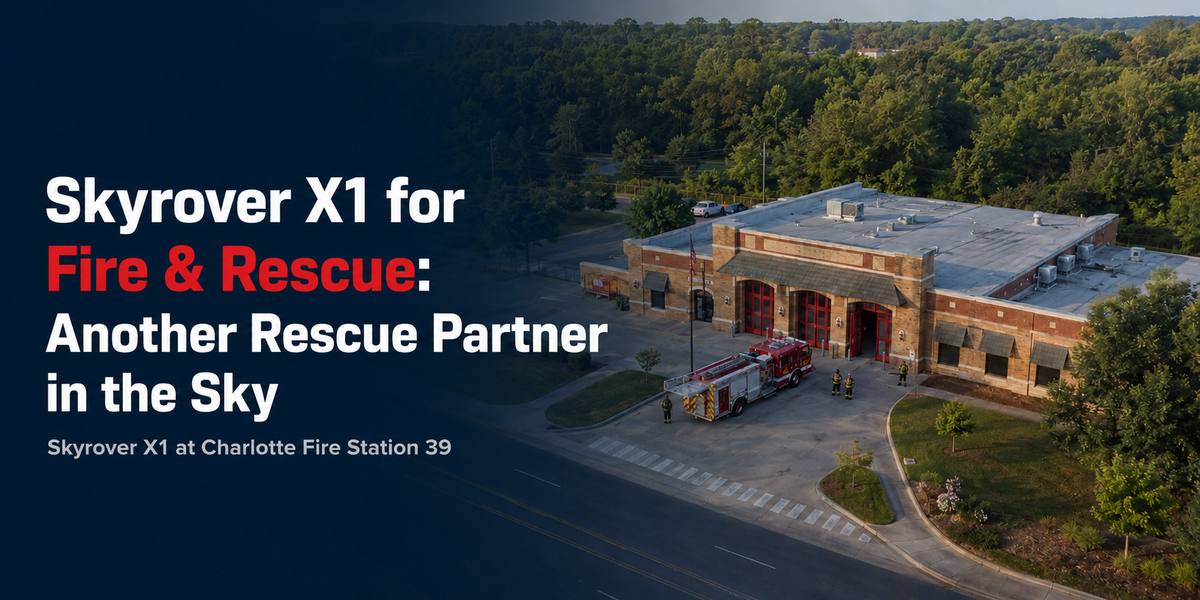
Two dogs and one cat came out safely. The fire stayed inside the garage. In just 11 minutes, crews brought the incident under control despite the intense July heat.
That outcome belonged to the firefighters who entered the building, searched the apartments, contained the flames, and protected the people and animals inside.
How a Drone for Fire and Rescue Can Support Scene Awareness
At an active incident, crews need useful information without unnecessary delay. An aerial view can provide added context around a structure and help incident leaders assess conditions from a perspective that may not be available at ground level.
The skyrover X1 supports 4K/60fps HDR video and 48MP photos. Its live view and high-resolution recorded imagery can give firefighters clearer visual references when assessing a scene, reviewing structural conditions, or supporting communication between field personnel and command.
This information remains only one part of a much larger operational picture. Firefighter observations, command protocols, professional imaging tools, and direct interior assessment remain essential.
Why this matters to firefighters: Aerial imagery may provide additional visual context that incident personnel can consider alongside established operational procedures.
Obstacle Sensing for Complex Incident Environments
Emergency scenes can be visually and physically crowded. Buildings, rooflines, utility poles, wires, trees, vehicles, and other obstacles may all be close to the flight area.
The skyrover X1 includes 360° obstacle sensing to provide additional flight assistance in complex surroundings. This can help a trained operator maintain awareness while positioning the aircraft around dense built environments.
Obstacle sensing is not a guarantee against collision. It does not replace pilot judgment, visual line of sight, a controlled flight area, or the department's emergency aviation procedures.
Why this matters to firefighters: Added obstacle awareness can support more controlled operation around common hazards found near residential and urban structures.
A Foldable, Under-249g Drone for Faster Deployment
Emergency equipment is most useful when crews can carry and deploy it without creating a new logistical burden. The skyrover X1 weighs under 249g and folds into a compact form, allowing it to fit into a small field kit.
Its portable design means a department can bring the aircraft to a scene without a dedicated transport case, large launch setup, or additional vehicle. Actual deployment should always follow department authorization, airspace rules, site safety procedures, and pilot requirements.
Why this matters to firefighters: A compact drone can be kept close at hand and prepared quickly when aerial context may help.
Up to 32 Minutes for One Focused Reconnaissance Mission
The skyrover X1 offers up to 32 minutes of flight time under optimal conditions. That gives an operator a practical window for a focused fire-scene reconnaissance or search-and-rescue support mission.
Real flight time varies with wind, temperature, flight mode, battery condition, and operational demands. Departments should plan conservatively, monitor battery status, and follow their own reserve and return-to-home procedures.
Why this matters to firefighters: A useful flight window can reduce interruptions while crews gather aerial context during a time-sensitive assessment.
The X1 should not be described as a substitute for a dedicated thermal imaging drone, professional handheld thermal cameras, or an agency's approved emergency aviation platform. Its appropriate role is to contribute additional aerial context alongside specialized tools and firefighter expertise.
Why this matters to firefighters: A compact visual drone may complement thermal information, but professional equipment and trained interpretation must remain central to operational decisions.
A Real Charlotte Fire Department Response
skyrover donated one X1 to the Charlotte Fire Department for equipment trial and evaluation. This was a single drone donation to the fire department, not a long-term supply agreement, exclusive partnership, or designation as official department equipment.
On July 21, 2026, the Charlotte Fire Department responded with Matthews Fire & EMS Engine 22 and Battalion 1 to a structure fire at 1826 Nantucket Lane. When Engine 39 arrived at Providence Court Apartments, crews found smoke coming from the garage of a two-story apartment building.
Engine 39 began attacking the garage fire. At the same time, firefighters from Ladder 39 and Engine 19 conducted an initial search inside the building.
Crews safely rescued two dogs and one cat. None of the animals was injured. Despite the day's high temperatures, firefighters kept the fire contained to the garage and prevented it from spreading into the living areas. The incident was controlled within 11 minutes.
One firefighter received treatment at the scene for a minor injury. The cause of the fire remains under investigation by the Charlotte Fire Investigation Task Force.
Firefighters operated the donated skyrover X1 during the incident to support fire-scene reconnaissance and thermal-imaging-assisted assessment. The original incident report did not describe the drone's exact flight path, specific observations, or tactical effect. For that reason, we do not claim that it identified a particular hazard, located an animal, or directly caused the successful outcome.
What we can say is simpler and more important: the aircraft was available to the firefighters as an auxiliary information tool while they carried out the work.
The Credit Belongs to the Firefighters
Technology can provide another viewpoint. It cannot enter a smoke-filled structure, carry an animal to safety, manage a rapidly changing scene, or make the difficult decisions demanded by an emergency.
We sincerely thank the Charlotte Fire Department, Engine 39, Ladder 39, Engine 19, Matthews Fire & EMS Engine 22, Battalion 1, and every responder involved. Their professionalism and courage under extreme heat and pressure protected the residents, contained the fire, and brought three pets out safely.
We also wish the injured firefighter a full recovery. skyrover is proud that the donated X1 could assist in a small supporting role, but the result belongs to the people who answered the call.
For departments exploring a drone for fire and rescue, the skyrover X1 can be considered as a compact visual support tool for evaluation and carefully governed field use. It should always operate within agency procedures and alongside, not in place of, professional emergency equipment and trained responders.
FAQ: Drones for Fire and Rescue
How do drones help firefighters?
Drones can provide an aerial view that supports scene awareness, exterior structural assessment, operational planning, and post-incident review. They are auxiliary tools and do not replace firefighter judgment, interior searches, command procedures, or specialized emergency equipment.
Can drones be used in search and rescue?
Yes. A drone for search and rescue can help teams view large or difficult-to-access areas from above. The aircraft, sensor package, pilot qualifications, airspace authorization, and operating procedures must match the mission.
What features are useful in a fire department drone?
Useful features may include a clear live view, reliable control, obstacle awareness, practical flight time, portability, and mission-appropriate sensors. The most suitable fire department drone technology depends on agency policy, training, environmental conditions, and the intended task.
Is the skyrover X1 professional firefighting equipment?
The skyrover X1 is a compact camera drone that can provide auxiliary aerial information. It is not a replacement for certified emergency aviation systems, dedicated imaging equipment, or professional firefighting tools. Any department use should be evaluated and governed by the agency responsible.
Explore more at: www.skyroverdrone.com



Leave a comment
This site is protected by hCaptcha and the hCaptcha Privacy Policy and Terms of Service apply.