
For many people, drones are associated with aerial photography, travel videos, or professional filmmaking.
But in classrooms around the world, drones are becoming something else entirely:
A powerful STEM learning tool.
As drone technology becomes more accessible, educators are finding new ways to use drones to teach science, technology, engineering, and mathematics through hands-on experiences that make learning more engaging and memorable.
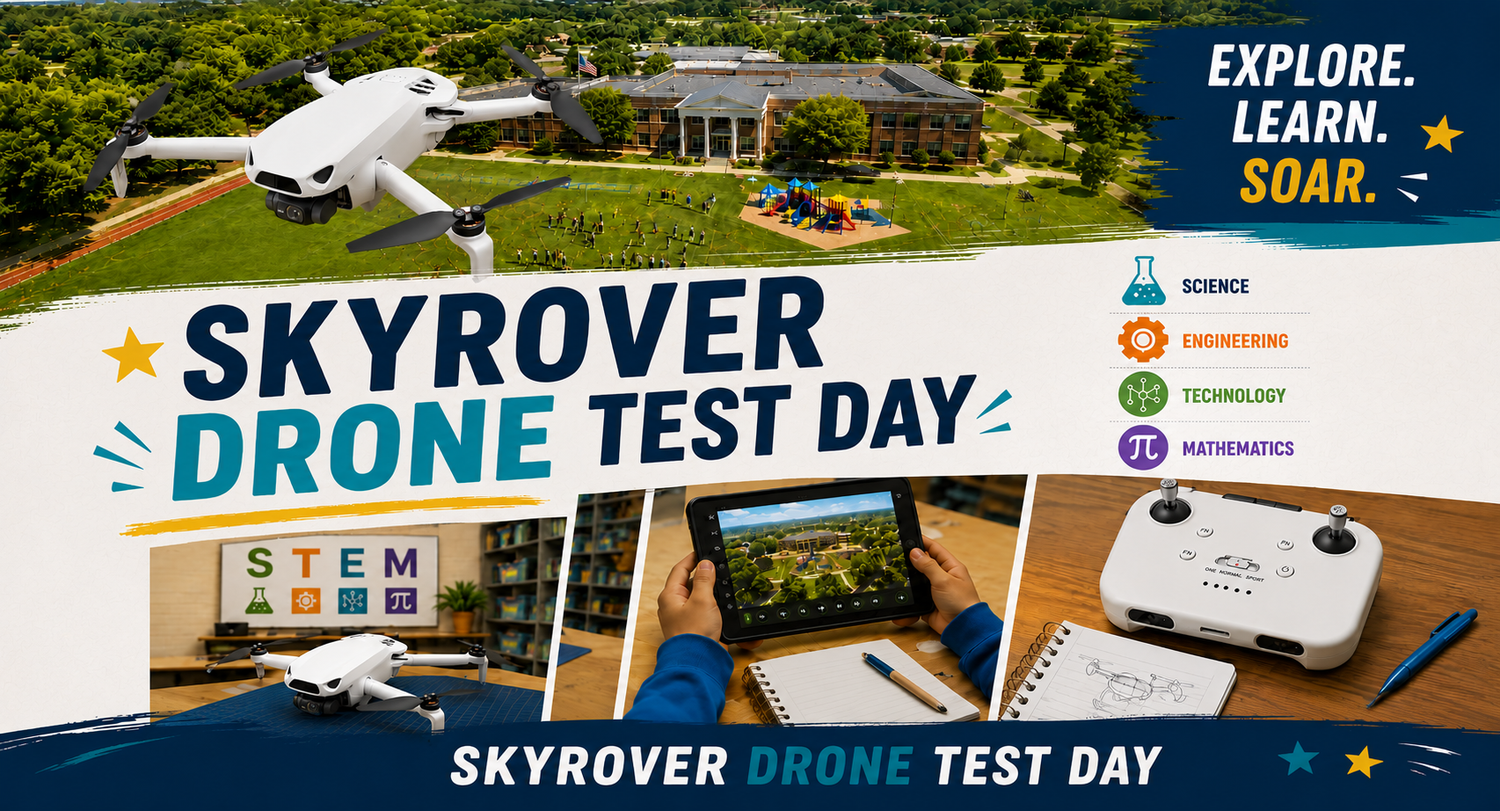
A Real-World Example: Skyrover Test Day at an Pennsylvania Elementary School
Recently, Skyrover hosted a Drone Test Day at an elementary school in Pennsylvania, giving students an opportunity to experience drone technology firsthand.
Throughout the event, students explored how drones fly, observed aerial imaging demonstrations, and learned how modern flight systems use sensors, cameras, and intelligent controls to operate safely and efficiently.
One of the most exciting moments was watching the drone capture aerial views of the school campus and outdoor activities. Students were fascinated by seeing familiar places from an entirely new perspective.
Teachers also noted how quickly students connected drone demonstrations with STEM concepts they had been learning in the classroom. Discussions about flight, engineering, navigation, and technology became more engaging when students could see these principles applied in real life.
The response was overwhelmingly positive. Students were eager to ask questions, participate in demonstrations, and learn more about how drone technology works. Events like this highlight how hands-on experiences can spark curiosity and inspire the next generation of innovators.
Bringing STEM Concepts to Life
One of the biggest challenges in STEM education is helping students connect abstract concepts with real-world applications.
Drones provide an opportunity to do exactly that.
Students can learn:
- Physics through flight dynamics and aerodynamics
- Mathematics through navigation, mapping, and measurement
- Engineering through drone design and problem-solving
- Technology through software, sensors, and autonomous systems
Instead of reading about these concepts in a textbook, students can see them in action.
Encouraging Problem Solving and Critical Thinking
Flying a drone is more than simply pressing a button.
Students often need to:
- Plan flight paths
- Analyze environmental conditions
- Solve navigation challenges
- Work together as a team
These activities encourage critical thinking and help develop practical problem-solving skills that are valuable far beyond the classroom.
Making Coding and Automation More Exciting
Many STEM programs now incorporate coding and robotics into their curriculum.
Drones can make these subjects more engaging by providing immediate visual feedback.
Students can learn how automated systems work by programming flight routes, understanding sensors, and exploring how intelligent flight functions are designed.
This transforms coding from a screen-based activity into a real-world experience.
Documenting School Events from a New Perspective
Drone technology also offers creative opportunities beyond STEM lessons.
Schools can use drones to document:
- Sports events
- Graduation ceremonies
- Field trips
- Campus activities
- Community projects
Aerial footage provides a unique perspective that traditional cameras often cannot capture.
Students can even participate in filming and editing, combining technology education with creative storytelling.
Inspiring Creativity Alongside Technical Skills
One of the most overlooked benefits of drones is their ability to blend technical learning with creativity.
Students are not only learning how technology works.
They are learning how to tell stories, communicate ideas, and capture experiences from new perspectives.
This combination of STEM skills and creative thinking is increasingly important in today's digital world.
The Future of Learning Is Hands-On
As educational technology continues to evolve, drones are becoming valuable tools for experiential learning.
They help students explore scientific principles, develop technical skills, collaborate with others, and express creativity in ways that traditional classroom tools cannot always provide.
The goal is not simply to teach students how to fly a drone.
The goal is to help them explore, create, and better understand the world around them.
And that may be one of the most exciting lessons technology can offer.
Explore more at: www.skyroverdrone.com



Leave a comment
This site is protected by hCaptcha and the hCaptcha Privacy Policy and Terms of Service apply.