
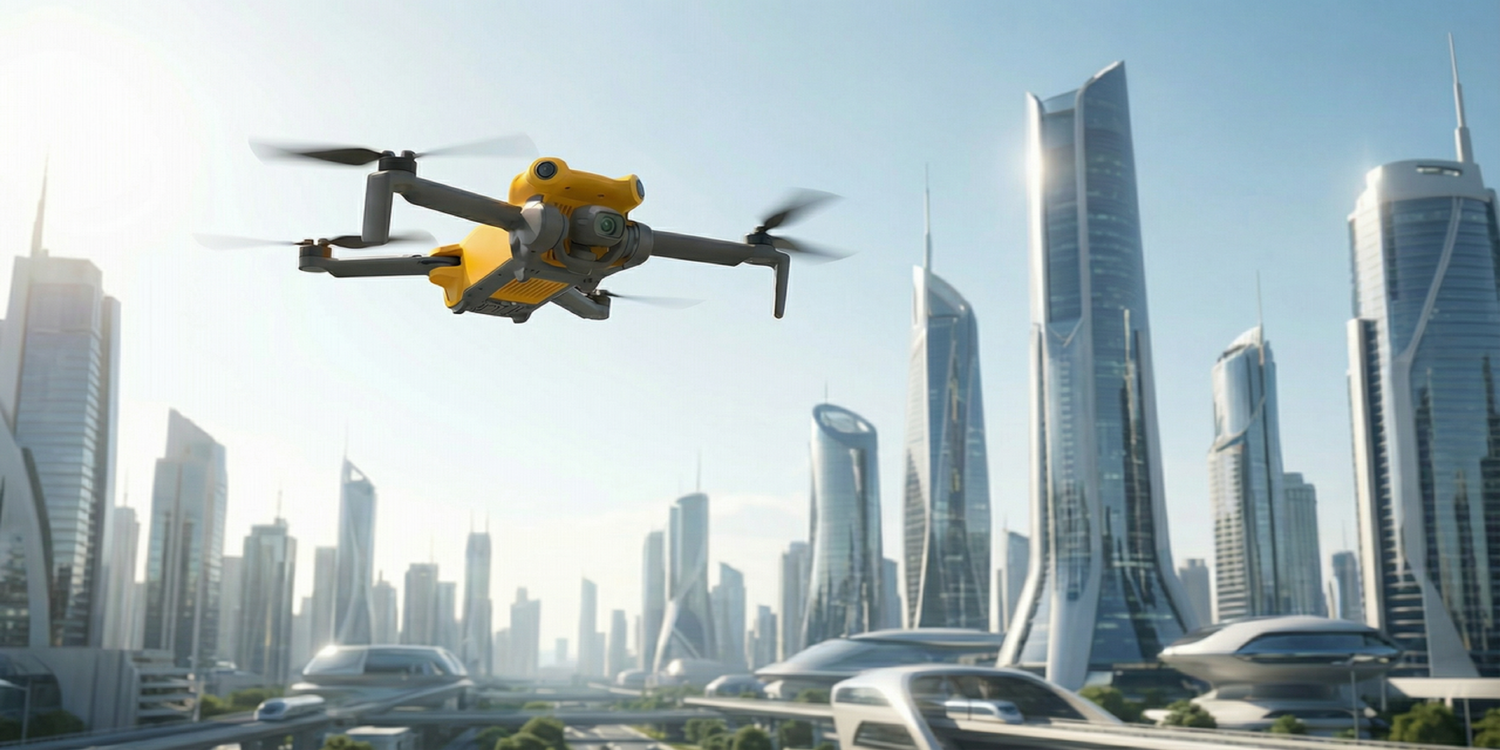
Mini drones have undergone a remarkable transformation over the past decade. Devices that once captured shaky 720p footage from vibrating plastic frames now house sophisticated imaging systems and autonomous navigation hardware, all packed into airframes weighing under 249 grams. The Skyrover X1 is a prime example of this evolution, combining a large 1/1.32-inch CMOS sensor capable of 4K/60fps HDR video with a full 360-degree obstacle avoidance system. But how exactly do manufacturers squeeze this level of capability into something that fits in the palm of your hand?
This article takes a technical deep dive into the engineering behind modern mini drone cameras and obstacle avoidance, explaining the core technologies without requiring an engineering degree to follow along.
Understanding Image Sensors: Why Size Matters
At the heart of every drone camera is an image sensor, a silicon chip that converts light into electrical signals. The physical dimensions of this sensor determine how much light it can gather, which directly impacts image quality, especially in challenging conditions like low light or high-contrast scenes.
Sensor size is typically expressed as a fractional inch measurement, a convention that dates back to vintage video tube standards. While the numbers themselves can be confusing (a "1-inch" sensor is actually about 13.2 mm diagonally), the principle is straightforward: a larger denominator means a smaller sensor.
Comparing Common Drone Sensor Sizes
| Sensor Size | Diagonal (mm) | Typical Use Case | Example Drone |
|---|---|---|---|
| 1/3.06 inch | ~5.2 mm | Entry-level toy drones | Basic models under $100 |
| 1/2 inch | ~8.0 mm | Mid-range consumer drones | Skyrover S1, DJI Mini SE |
| 1/1.32 inch | ~12.0 mm | Advanced sub-250g drones | Skyrover X1 |
| 1/1.3 inch | ~12.0 mm | Premium compact drones | DJI Mini 4 Pro |
| 1 inch | ~13.2 mm | Professional compact drones | DJI Air 3S, Skyrover models |
The Skyrover X1's 1/1.32-inch sensor is notably larger than what you find in most drones under 249 grams. This matters because a larger sensor captures more photons per pixel, which translates to less image noise, better dynamic range, and superior performance in low-light conditions. According to Cambridge in Colour's sensor size guide, doubling the sensor area roughly doubles the light-gathering capability, all else being equal.
Pixel Binning: High Resolution from Small Sensors
The X1's sensor produces 48-megapixel still images, but you might wonder how a sensor this small can deliver that many pixels without each pixel being too tiny to capture useful light. The answer is pixel binning.
In a 48MP sensor using a quad-bayer arrangement, every group of four adjacent pixels shares the same color filter. During video capture or lower-resolution stills, the image signal processor (ISP) combines these four pixels into one "super pixel." This process, called 4-to-1 pixel binning, produces an effective 12-megapixel output where each pixel is four times larger in area than the individual sensor pixels.
Why Pixel Binning Matters for Drone Video
- Better low-light performance: Larger effective pixels gather more light, reducing visible noise in dawn, dusk, or overcast conditions.
- Improved dynamic range: The ISP can read neighboring pixels at different exposures simultaneously, enabling HDR processing in a single capture rather than requiring multiple frames.
- Flexible output: The same sensor can produce 48MP stills (using the full resolution) or 12MP-equivalent video with better per-pixel quality.
For 4K video (approximately 8.3 megapixels per frame), the binned 12MP output provides more than enough resolution while maintaining excellent light sensitivity. This is why the X1 can shoot usable 4K/60fps HDR footage from a sub-250g platform without the footage looking noisy or flat.
For a detailed technical breakdown of pixel binning architectures, Sony Semiconductor's STARVIS documentation provides excellent insight into how backside-illuminated (BSI) sensors achieve high sensitivity in compact formats.
Gimbal Stabilization vs. Electronic Image Stabilization
Stable footage requires some form of image stabilization, and there are two fundamentally different approaches: mechanical (gimbal-based) and electronic (software-based).
3-Axis Mechanical Gimbal
A 3-axis gimbal uses brushless motors and MEMS gyroscopes to physically counteract drone movement in real time across three rotational axes: pitch (tilt up/down), roll (tilt left/right), and yaw (pan left/right). The Skyrover X1 uses this approach.
The advantages are significant:
- No crop penalty: Because the camera itself is being physically leveled, the full sensor area is used for every frame, meaning no resolution is lost to stabilization.
- Handles large movements: A gimbal can compensate for several degrees of rotation, far more than EIS can correct without visible artifacts.
- Smooth cinematic motion: The motors create intentional, controlled camera movements rather than fighting against them, resulting in fluid pans and tilts.
The trade-off is weight, complexity, and power consumption. A 3-axis gimbal adds grams, requires calibration, and draws battery power, which is why not every mini drone includes one.
Electronic Image Stabilization (EIS)
EIS works entirely in software. The ISP analyzes each frame, detects unwanted motion by tracking features across consecutive frames, and crops/rotates the image to stabilize it. Some drones use EIS as a supplement to a simpler single-axis or 2-axis gimbal, while others rely on it entirely.
The limitations of EIS include:
- Crop factor: To have room to shift the image, EIS must use a smaller portion of the sensor, reducing effective resolution and field of view.
- Rolling shutter artifacts: When the drone moves rapidly, EIS can introduce wobble or jelly-like distortion because it is correcting after the fact rather than preventing the motion.
- Latency: There is always a slight delay in EIS correction, which can result in micro-jitters during fast maneuvers.
For the Skyrover S1, which uses a 1/2-inch Sony CMOS sensor paired with a 3-axis gimbal, the mechanical stabilization ensures that even at the lower sensor resolution, footage remains smooth and free of software-induced artifacts.
Lens and Aperture: The Overlooked Variables
Sensor size and pixel count get most of the attention, but the lens in front of the sensor is equally important. The Skyrover X1 features an f/1.7 aperture, which is notably wide for a drone camera at this price point.
A wider aperture (lower f-number) allows more light to reach the sensor per unit of time, which provides several benefits:
- Cleaner video in dim conditions: At f/1.7, the X1 can maintain reasonable ISO values at sunset or during golden hour, reducing noise.
- Faster shutter speeds: More light means the camera can use faster shutter speeds while maintaining proper exposure, freezing motion more effectively during high-speed flight.
- Natural bokeh in close-up shots: While not a primary consideration for aerial footage, the wider aperture produces a shallower depth of field for close-range creative shots.
By comparison, many competing drones in the sub-250g category use f/2.4 or f/2.8 apertures, which let in roughly half the light of the X1's f/1.7 lens. This difference is particularly noticeable during the X1's Super Night Mode, where the wider aperture gives the sensor a meaningful head start in capturing ambient light.
How Obstacle Avoidance Sensors Work
Obstacle avoidance in modern drones relies on multiple sensor types working together, a concept known as sensor fusion. Each sensor technology has different strengths and limitations, so combining them provides more robust detection than any single type could achieve alone.
Stereo Vision Cameras
Stereo vision uses two cameras spaced a known distance apart (like human eyes) to calculate depth through parallax. By comparing the slight differences between what each camera sees, the drone's processor triangulates the distance to objects in its field of view.
This approach provides:
- Rich spatial data: Unlike simple proximity sensors, stereo vision generates a depth map of the environment, allowing the drone to understand the shape and size of obstacles.
- Good accuracy at moderate distances: Effective detection typically ranges from about 0.5 meters to 15 meters, depending on the camera resolution and baseline distance.
- Texture dependence: Stereo vision struggles with uniform surfaces (clear glass, plain walls) because it needs visual features to match between the two cameras.
The Skyrover X1's 360-degree obstacle avoidance system relies primarily on stereo vision cameras placed around the airframe, giving it awareness in all directions. The Skyrover S1 uses forward-facing stereo vision for obstacle detection ahead of the drone, which covers the most critical direction for forward flight.
Time-of-Flight (ToF) Sensors
ToF sensors emit infrared light pulses and measure the time it takes for the reflected light to return. Since light travels at a known speed, the round-trip time directly corresponds to distance.
ToF sensors offer:
- Fast, precise measurements: Capable of millimeter-level accuracy at short ranges.
- Independence from texture: Works equally well on glass, walls, or textured surfaces.
- Compact form factor: Small enough to fit on the sides or bottom of a mini drone.
The limitation of ToF is range. Most ToF sensors on consumer drones are effective only up to about 5-8 meters, making them better suited for close-proximity detection rather than long-range obstacle warning.
Ultrasonic and Barometric Sensors
Ultrasonic sensors emit high-frequency sound waves and listen for the echo, similar to how bats navigate. These are primarily used for ground detection during landing and low-altitude flight, where optical sensors may struggle with grass, water, or uneven terrain.
Barometric sensors measure air pressure to estimate altitude. While not used for obstacle avoidance directly, they help maintain consistent flight height, which indirectly contributes to safe navigation by preventing unintended altitude loss.
Sensor Fusion: Combining Data for Reliability
The real magic of modern obstacle avoidance comes from sensor fusion, the process of combining data from multiple sensor types into a unified understanding of the environment. The drone's flight controller continuously integrates inputs from stereo cameras, ToF sensors, ultrasonic sensors, IMUs (inertial measurement units), and GPS to build a real-time 3D model of its surroundings.
This fusion approach provides redundancy. If one sensor type is blinded (for example, stereo cameras facing direct sunlight), others can fill the gap. The IMU data helps predict the drone's trajectory, allowing the system to anticipate collisions before they happen rather than simply reacting to detected obstacles.
AI algorithms running on dedicated processors evaluate this fused sensor data to determine safe flight paths. The Skyrover X1's system can identify obstacles, calculate alternative routes, and adjust its trajectory autonomously, all within milliseconds. This is what enables features like ActiveTrack-style subject following, where the drone must avoid obstacles while simultaneously tracking a moving subject through complex environments.
Putting It All Together
The engineering inside a modern mini drone like the Skyrover X1 represents a careful balancing act. A large 1/1.32-inch CMOS sensor with pixel binning delivers high-resolution 4K video with usable dynamic range. A wide f/1.7 aperture maximizes light gathering. A 3-axis mechanical gimbal ensures stable footage without sacrificing resolution to software correction. And a multi-sensor obstacle avoidance system with stereo vision, ToF, and ultrasonic sensors provides 360-degree environmental awareness.
None of these technologies are unique to a single manufacturer, but the integration and tuning of all these systems into a sub-249-gram package is where the engineering challenge lies. The result is a device that can produce genuinely cinematic footage while keeping both the drone and its surroundings safe, a combination that was simply not possible in this weight class even a few years ago.
For creators who want to understand what they are flying and why it performs the way it does, this knowledge can help you push the equipment to its limits while staying within safe operating boundaries.
Explore the Skyrover X1 and its full suite of imaging and safety features at www.skyroverdrone.com



Leave a comment
This site is protected by hCaptcha and the hCaptcha Privacy Policy and Terms of Service apply.